Urbanism and real estate in Paris: understanding the transformations of the city

Paris is often described as a “museum city”, frozen in its history and heritage. However, this image does not stand up to observation from the ground. The capital is crossed by numerous urban planning projects that are profoundly transforming its neighborhoods, their uses and their attractiveness.
Behind the major construction projects, developments, and space allocated to new forms of mobility, it is the structure of the city that is changing. These transformations, sometimes subtle, sometimes highly visible, have a lasting impact on the daily lives of residents... and, as a result, on the Paris real estate market.
Talking about buying real estate in Paris usually means discussing price per square meter, the condition of an apartment, or the quality of a building. Urban planning remains an underestimated factor in most cases, even though it has a direct impact on the attractiveness of a neighborhood, its uses, and, as a result, the value of real estate.
Major projects, redevelopment of public spaces, new forms of mobility, greening of public spaces: these developments are not transforming Paris in a uniform way. Some neighborhoods are gaining in quality of life and attractiveness, while others are going through more complex transition phases, sometimes creating opportunities, sometimes constraints.
The aim of this article is to explore the link between urban planning and real estate in Paris. We will attempt to analyze how urban planning projects are transforming Paris and the impact they are having on real estate buyers today.
1- Urban planning and real estate in Paris: a long-term link
Urban planning in the history of Paris
In Paris, urban planning is neither a recent nor a trivial phenomenon. For more than a century, major transformations of the city have always had a direct impact on how neighborhoods are used, their sociology, and, inevitably, the real estate market. Haussmann's renovations are the most iconic example, but they are only one of many episodes in a city that is constantly adapting.
Far-reaching transformations
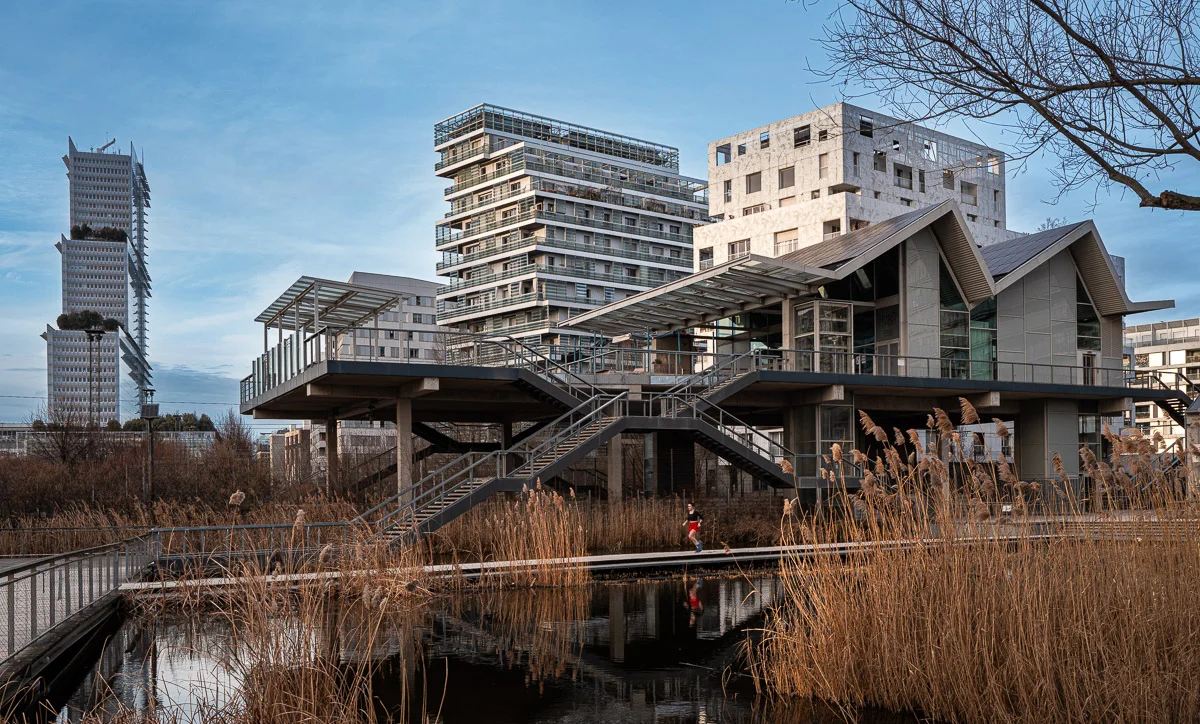
Contrary to popular belief, urban planning projects are not limited to aesthetic or technical operations. They redesign traffic flows, modify access points, transform public spaces, and have a concrete influence on the way residents experience their neighborhood on a daily basis. For example, the creation of the new Paris courthouse at Porte de Clichy is a particularly telling illustration of this. An entire neighborhood has been structured around this major facility, organized around Martin Luther King Park, which has become a central element in the residential appeal of the area. The new buildings, designed to high environmental standards, offer fluid uses, high-quality common areas, and a level of comfort rarely associated with historically peripheral Parisian neighborhoods. Today, apartments with unobstructed views of the park are fetching high prices, revealing the direct impact of urban planning on the real estate market. This project shows how the combination of green spaces, well-designed urban functions, and architectural quality can permanently transform the perception of a neighborhood and influence property values.
As a property hunter, I had the opportunity to assist two clients in their search for an apartment in this neighborhood. I was very pleasantly surprised by the quality of the buildings, the common areas, and the infrastructure on offer. Both of my clients bought apartments overlooking Martin Luther King Park. Few neighborhoods in Paris offer such a high quality of life: a great success for a recent urban development project.
More or less significant influences on real estate
However, it is essential to distinguish between the short-term effects of structural transformations. The example of the Les Halles neighborhood is indicative of the long time frame typical of major urban projects in Paris. Announced, debated, and then carried out over several decades, the redevelopment of Les Halles has long been associated with significant nuisances, a degraded image of the neighborhood, and a strong lack of understanding of its future uses. During the last phase of construction, the residential attractiveness of the area remained mixed, despite the scale of the project. The impact on real estate prices was not felt. This neighborhood of Paris is still perceived as one of the least attractive in the hyper-center of Paris from a real estate perspective. As perceptions of the neighborhood around Rue Saint Denis have been changing for the better for several years, the same could happen for the Les Halles neighborhood: to be continued...
Uneven urban impacts
Urban planning rarely acts as a uniform lever. The same project can have very different effects depending on the streets, buildings, and the way in which new flows are distributed throughout the neighborhood. Some addresses benefit from a clear improvement in their immediate environment, thanks to higher-quality public spaces, calmer traffic, or new uses. Others, on the other hand, may face increased traffic, greater noise pollution, or a loss of tranquility. At this very fine scale, sometimes street by street, the impact on property values depends less on the project itself than on how it actually transforms the daily lives of residents. This micro-local perspective is essential to understanding why an urban project may be perceived as an opportunity for some properties and as a constraint for others.
Pedestrianization and traffic calming: a very targeted benefit
In some neighborhoods, pedestrianization or road redevelopment projects have significantly improved the quality of lifeon streets that were previously heavily exposed to motor vehicle traffic. Reduced traffic, wider sidewalks, and the creation of green spaces have made certain addresses more pleasant to live in and more attractive for residential purposes.
Conversely, these same projects have sometimes shifted traffic flows to adjacent roads, generating more traffic, noise, and foot traffic for other streets in the neighborhood. Thus, two buildings located just a few dozen meters apart may see their attractiveness evolve in opposite directions, even though they are part of the same urban project.
{{cta-vert-en}}
2- Greater Paris and the Grand Paris Express: a change of scale
The Grand Paris Express aims to break away from the ultra-centralized model of Paris. It seeks to improve traffic flow around Paris and create a more balanced and better-connected megacity. From a real estate perspective, the appeal seemed immediate, but on the ground, the reality is quite different.
Presentation of Greater Paris
Greater Paris is not just a transportation project. It is a broader vision of metropolitan development, integrating housing, economic activities, public facilities, and mobility. The goal is to better connect Paris to its inner and middle suburbs, while developing new centers of life capable of reducing dependence on the historic center of the capital.
The Grand Paris Express
At the heart of this project, the Grand Paris Express is the most visible lever. With the creation of new automated metro lines and numerous stations, it is profoundly redrawing the map of travel in the Île-de-France region. These infrastructures are changing travel times, bringing cities that were previously considered remote closer together, and making areas that were previously difficult to access more accessible.
The lines are being brought into service gradually, sometimes over several years. The effects on real estate are neither instantaneous nor systematically correlated with the announcement of a new station.
Contrasting effects on real estate
The presence of a new Grand Paris Express station is clearly not enough to increase real estate prices in its vicinity. The differences are sometimes significant from one station to another. The proximity of new stations near Pont de Sèvres, Issy-les-Moulineaux, Clamart, and Massy-Palaiseau has seen real estate prices fall, even before the crisis that began in 2022. Other stations located in Aubervilliers and Bobigny have a clearly positive impact on the real estate market.
We saw this in a specific case where we assisted a first-time buyer in purchasing an apartment near the Clamart train station. When we began the search and drew up the specifications, our buyer asked us about the Clamart train station neighborhood. He was interested in the neighborhood but was concerned that the new Grand Paris Express station had caused real estate prices to skyrocket. We reassured him that there had been no price increase compared to other neighborhoods in Clamart or nearby towns.
An essential caveat
It is important to remember that price increases linked to the Grand Paris project are neither widespread nor immediate. Some areas are experiencing gradual change, while others remain in a longer transition phase.
The Grand Paris and Grand Paris Express projects are therefore opening up new opportunities in real estate, but they also call for a cautious approach. Understanding these projects and observing fluctuations in real estate prices means, above all, being able to distinguish between structural changes that are beneficial to the real estate market and those that are less so.
3 - Mobility, public spaces, and quality of life: redesigned urban balances
A global transformation of how the city functions
In Paris, recent developments in mobility and public space planning have profoundly changed how the city functions. The development of bike lanes, the gradual reduction of car traffic, the partial pedestrianization of certain areas, and increased greening: these transformations now affect the entire Parisian territory. They are part of a global and relatively homogeneous evolution of the capital, rather than a neighborhood-by-neighborhood approach. The subject is much talked about and arouses as much enthusiasm as it does rejection.
Different effects at street level
However, while the transformation is widespread, its effects are not uniform. New mobility and the redevelopment of public spaces do not have the same consequences depending on the roads, streets, and existing uses. Some areas are becoming more livable, while others are becoming alternative routes, with more traffic and nuisances. Here again, the impact is on a small scale, often street by street.
République: redevelopment in line with existing dynamics
The renovation of Place de la République is a good example of this approach. The renovation of the square alone did not create the attractiveness of the area. This is part of a broader dynamic: strong centrality on the right bank, growing concentration of professional activities in the east and north of Paris, exceptional public transport links, and the development of a dense offering of restaurants, bars, and entertainment venues. The redevelopment of the square has played a supporting and accelerating role, making these uses more visible and coherent, without being the sole driving force.
At our apartment hunting agency, we are seeing growing enthusiasm for the République neighborhood among young professionals.
Buyers' expectations are more focused on the urban environment
From a real estate perspective, these developments have not changed the nature of the Parisian market, but they have reinforced the attractiveness of certain already well-positioned areas. Buyers' profiles have not fundamentally changed in terms of mobility, but they are paying increasing attention to ease of travel, the quality of public spaces, and the actual comfort of their daily environment. A well-connected and lively neighborhood will naturally be more sought after than an area that is poorly connected or unbalanced by poorly controlled traffic flows.
Real estate value put to the test by the urban experience
In this context, the value of a property is no longer determined solely by its intrinsic characteristics, but by the urban experience offered by its immediate environment. In Paris, quality of life is not determined at the district level: it is built at the intersection of mobility, uses, and the way in which a space is actually experienced on a daily basis.
A telling criterion: the growing importance of bicycle storage
A telling demand: more and more buyers who use our property hunting service are asking us for bicycle storage in their future building.
4 - Urban planning and real estate: a measure of anticipation... and a measure of risk
Buying in a neighborhood undergoing transformation necessarily involves an element of risk. Even with in-depth analysis of urban projects, there is always a degree of uncertainty. Urban planning cannot be controlled like a perfectly mastered mechanism. Its real effects cannot be predicted in advance.
When a buyer chooses to move to a neighborhood undergoing change, they are taking a calculated but very real risk. The announced transformations may improve the quality of life and attractiveness of the area in the long term, but they may also produce more mixed, even disappointing, results. Some projects result in more pleasant, better organized, and more sought-after neighborhoods; others, despite ambitious intentions, ultimately change little in terms of the neighborhood's uses or image.
With hindsight, some examples appear to be obvious successes. Areas such as Beaugrenelle have undergone a profound transformation, accompanied by a tangible increase in property values around new facilities and a structuring commercial offering. Conversely, other neighborhoods, despite being driven by major projects, have evolved more slowly or in a more contrasting manner, without causing a real shift in terms of residential attractiveness. I would cite the example of Les Halles here.
It is also important to remember that the success of certain projects was not easy to anticipate. Before the construction of the new courthouse and the development of the neighborhood around Martin Luther King Park, few observers would have been able to predict with certainty the quality of the final result and the level of real estate appreciation achieved today by certain properties.
Analysis therefore reduces risk, but does not eliminate it. It helps to understand the dynamics at play without guaranteeing a specific outcome. Buying in a neighborhood undergoing transformation means accepting this element of uncertainty.
In the complex Parisian market, this clarity is essential. Urban planning offers opportunities, but it never constitutes a definite promise. Recognizing this element of risk means adopting a healthier and more realistic approach to real estate investment in Paris.
{{cta-bordeaux-en}}
Understanding the city to make better purchases
In Paris, urban planning and real estate are closely linked. Changes in the city, whether driven by major projects or more diffuse shifts in mobility and usage, influence the real estate market without ever producing automatic or uniform effects.
There is no simple interpretation. An urban project can transform a neighborhood permanently, or it can only partially change its uses or image. Even projects that are now perceived as successes were not necessarily easy to anticipate at the outset. Buying in a city undergoing transformation therefore always involves an element of risk, which analysis can reduce but never completely eliminate.
Particularly over the last fifteen years or so, as climate, environmental and quality of life issues have become increasingly important in urban planning, Parisian real estate can no longer be considered independently of the city's development. Accepting this complexity means giving ourselves the means to make more informed choices.
The latest news from the Paris real estate market
All news