Condominium fees: How can you tell if they're normal or too high?

When you visit an apartment, there’s one question that always comes up: “How much are the maintenance fees?” €250 per month? That seems reasonable. €500? Many buyers start to hesitate. However, the amount of the maintenance fees, taken on its own, doesn’t tell you whether an apartment is a good deal or not. In reality, high maintenance fees can be perfectly justified. Conversely, very low maintenance fees can sometimes mask a poorly maintained building. The key, then, isn’t to find the lowest maintenance fees, but to understand what they cover.

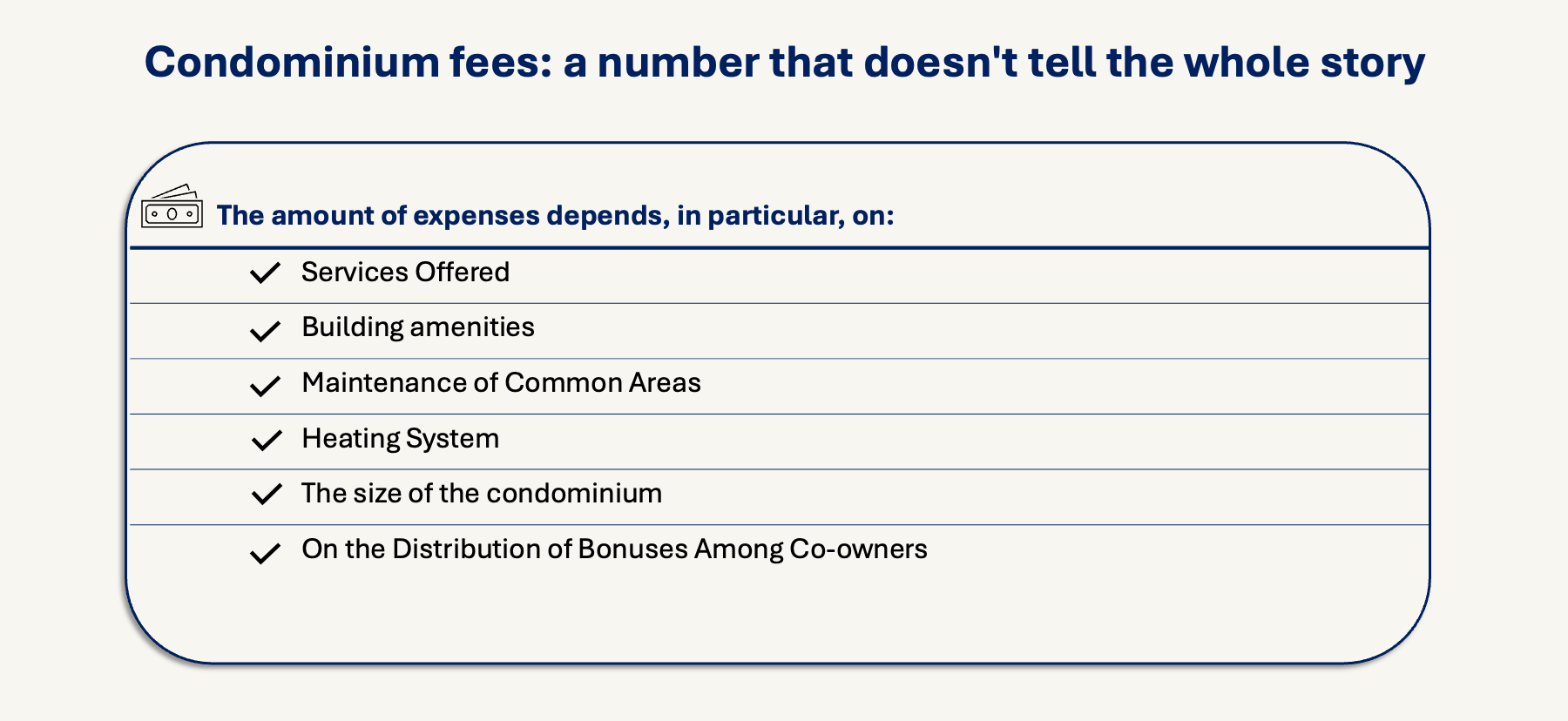
The amount of the maintenance fees alone doesn't mean much
Two apartments may each have exactly €450 in monthly maintenance fees, yet represent very different costs for their owners.
Why?
Because maintenance fees don't cover the same expenses.
Depending on the building, they may include:
- central heating;
- hot water;
- cold water;
- the elevator;
- the building superintendent;
- cleaning of common areas;
- maintenance of green spaces;
- condominium insurance;
- the property manager’s fees.
Let’s take an example.
The first apartment has €450 in monthly maintenance fees, but this amount includes heating, hot water, a building superintendent, and an elevator.
The second apartment also has €450 in fees, but it has individual heating. You’ll therefore need to add gas or electricity usage, boiler or heat pump maintenance (depending on the situation), as well as certain expenses not included in the condominium fees.
Ultimately, even with the same monthly fees, the two units can have very different overall costs.
That’s why comparing only the monthly amount is often misleading.
Low fees aren’t always good news

This is probably the idea that surprises buyers the most.
Many people think that a condominium with low maintenance fees is necessarily well-managed.
In practice, this isn’t always the case.
Some condominiums try to keep maintenance fees very low by postponing expenses year after year.
Minor repairs are put off.
Maintenance is limited to the bare minimum.
Decisions are systematically postponed at general meetings to avoid any increase in special assessments.
At the time, this may seem advantageous.
But a few years later, the condominium association may have to finance, all at once, a facade renovation, a roof repair, the replacement of the boiler, or the renovation of common areas.
Co-owners are then faced with significant special assessments that could have been spread out over time.
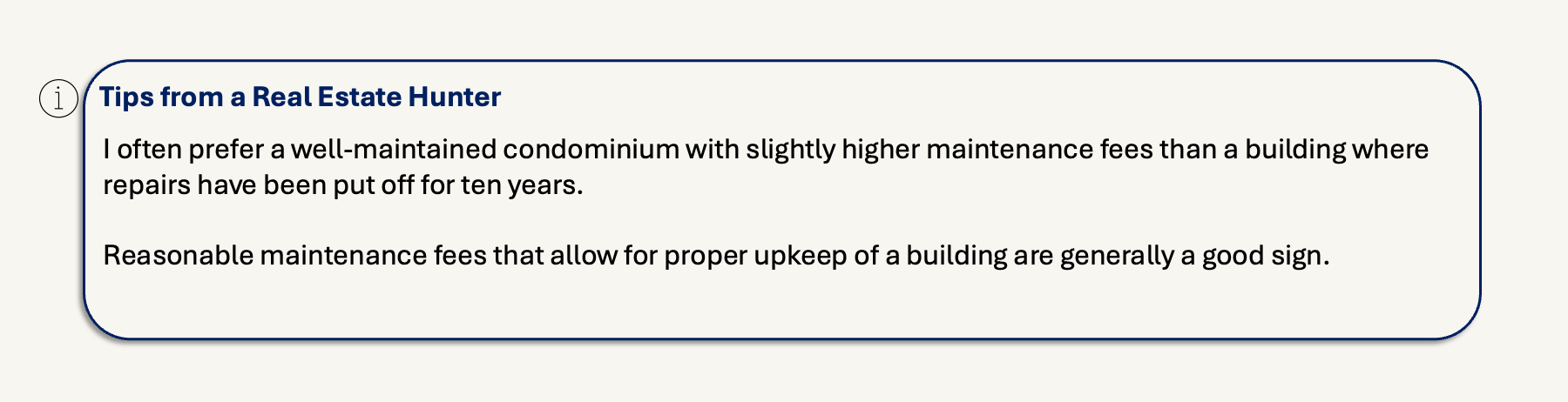
During our apartment searches, we regularly come across buildings where the maintenance fees seem attractive at first glance. However, upon reading the minutes of the general meetings, we discover that the same projects have been postponed for several years.
The real issue, therefore, is not the level of the maintenance fees.
It is the quality of the condominium’s management.
What You Really Need to Look Into Before Buying
The amount of the maintenance fees is just one piece of information.
The condominium documents, on the other hand, tell the whole story of the building.
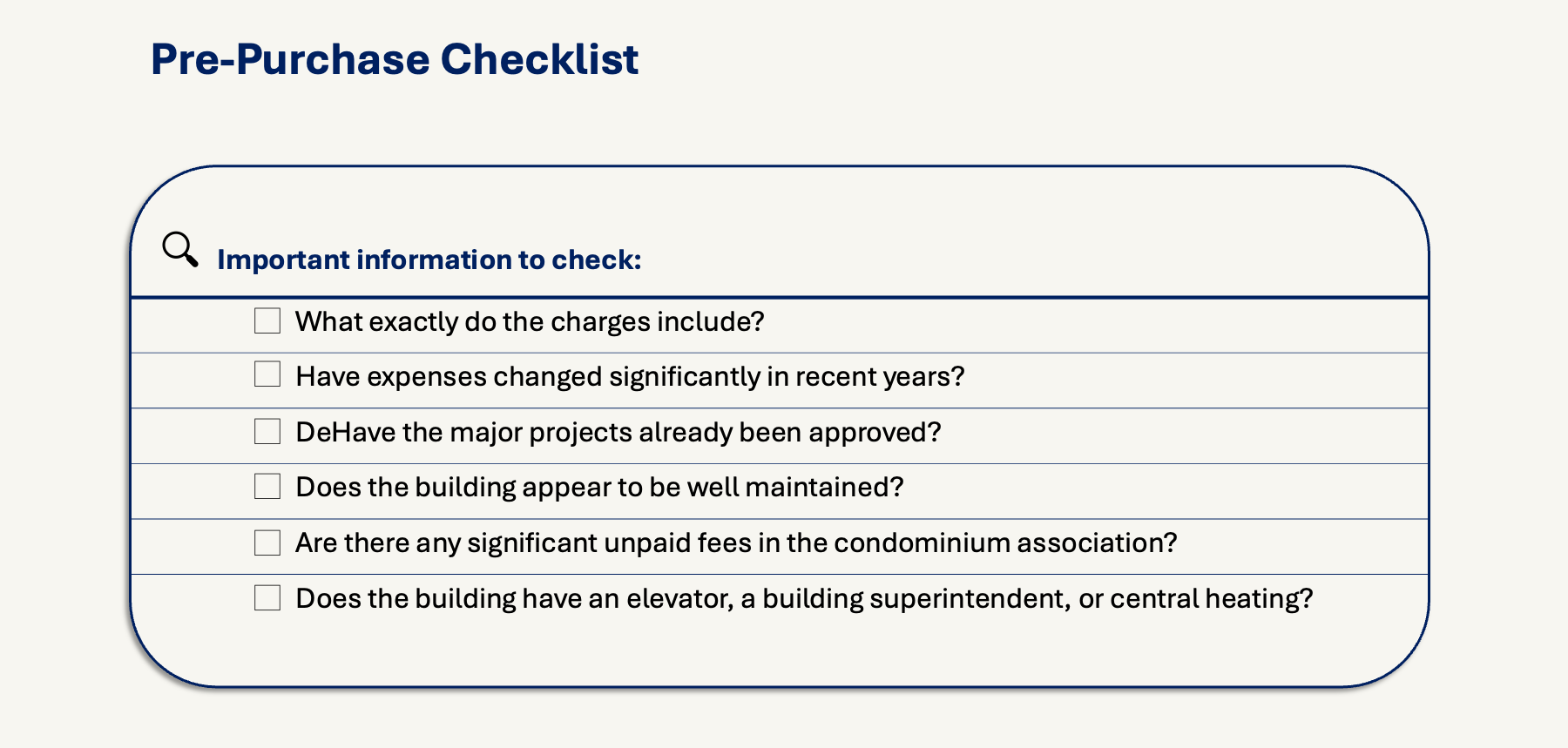
Before buying, it’s helpful to request:
- the most recent maintenance fee statements;
- the homeowners’ association’s projected budget;
- the minutes from the last three general meetings;
- any renovation projects that have already been approved;
- any renovation projects that are being considered or discussed.
These documents help answer much more important questions.
Are the maintenance fees increasing regularly?
Is the homeowners’ association properly maintaining the property?
Are any major expenses planned for the coming years?
Do the co-owners seem to make decisions calmly, or do discussions always revolve around a lack of funds?
In just a few dozen pages, you can often gain a much better understanding of a building’s condition than by simply looking at a number in a real estate listing.
Can you compare maintenance fees between two apartments?
Yes.
But only if the buildings are comparable.
Comparing the maintenance fees of an older building with a caretaker, an elevator, central heating, and a garden to those of a small building without an elevator or amenities doesn’t make much sense.
For a comparison to be meaningful, you need to look at condominiums with similar characteristics:
- a similar size;
- comparable amenities;
- an equivalent heating system;
- a similar level of services;
- comparable maintenance quality.
In other words, you have to compare like with like.
Situations that should really catch your attention
Certain situations, however, warrant a more in-depth analysis.
For example:
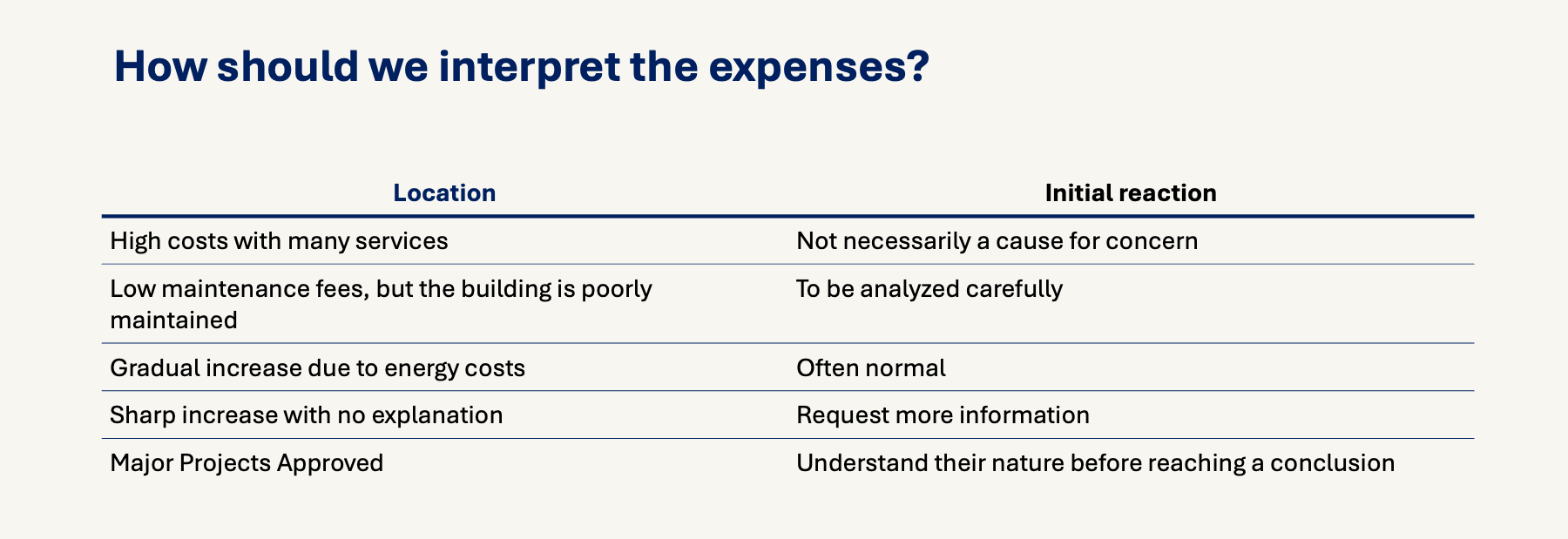
- a very significant increase in maintenance fees without a clear explanation;
- numerous unpaid bills within the condominium association;
- a building requiring major repairs with no funding planned;
- minutes of general meetings showing recurring difficulties in approving necessary expenditures;
- visibly inadequate maintenance of common areas.
In these cases, the amount of the maintenance fees becomes almost secondary.
The real issue is whether the condominium association is in good financial health and whether it will be able to properly maintain the building in the years to come.
Key Takeaways
Condominium fees are never just a simple monthly amount.
What really matters is what they cover, how the condominium is managed, and the expenses you might face after your purchase.
When we evaluate an apartment for a client, we never just look at the amount of the fees. Above all, we seek to understand what it reveals about the building’s day-to-day operations.
It’s often this analysis that helps avoid unpleasant surprises… or, conversely, prevents you from ruling out an excellent apartment simply because its fees seemed high at first glance.
To better understand:
The latest news from the Paris real estate market
All news